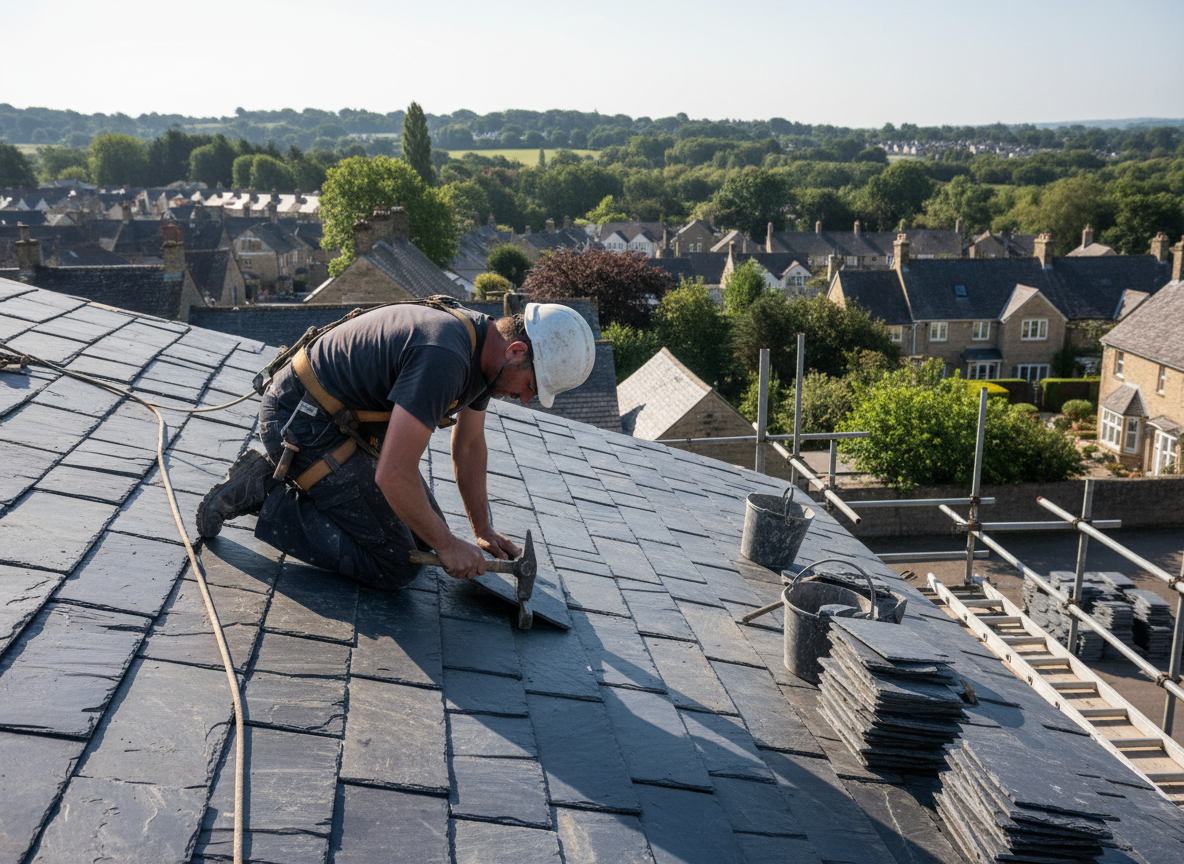
Slate roofing requires careful selection of natural stone tiles that match the weight limits and pitch of homes built in Oakley during the early twentieth century. Many properties near Oakley Square and the surrounding Hamilton County streets still carry original Welsh or Pennsylvania slate that has lasted decades but now shows delamination or nail fatigue. Proper underlayment and copper flashing details become critical when replacing sections because freeze-thaw cycles common to southwest Ohio can force moisture behind loose tiles and rot the decking below.
Edge cases we see regularly involve slate roofs on two-story brick homes where the original battens have shifted or the ridge has settled unevenly. Removing and resetting individual tiles without disturbing adjacent courses demands hand tools and patience; power nailers often crack the stone. Local building practices in Cincinnati also call for ice-and-water shield along eaves and valleys, a step that must be coordinated with slate layout to avoid telegraphing through the finished surface.
Homeowners sometimes attempt spot repairs with mismatched synthetic slate that expands differently from natural stone, creating leaks at the transitions. We always verify substrate integrity first and recommend full-section replacement when more than fifteen percent of the field shows wear. This approach keeps the roof plane consistent and prevents the patchwork appearance that shortens overall service life.
Technician insight
In Oakley the thing that catches most people out with slate roofing is the extra weight on early-1900s balloon-frame houses near Madison Road; many were never engineered for the layered underlayment we now install, so we routinely add sistered rafters before resetting tiles.
Slate Section Replacement Near Oakley Square
Loose tiles on a two-story brick home allowed water to reach the deck after winter storms. Inspection showed rotted battens and shifted flashing at the valley. We replaced the affected slate course, installed new copper valleys, and reinforced the decking. The roof now sheds water without further intrusion.
How it works
- 1
Site Assessment
Walk the roof and attic to check slate condition, decking, and flashing while noting access constraints typical of Oakley streets.
- 2
Material Selection
Match existing slate color, thickness, and texture from regional suppliers and confirm structural capacity for the chosen stone.
- 3
Removal and Preparation
Carefully strip damaged sections, replace compromised sheathing, and install new underlayment and copper valleys.
- 4
Installation and Finishing
Lay new slate with proper overlap, secure with copper nails, and seal all penetrations before final inspection.
Pricing
Upfront quotes after on-site review; final cost depends on roof size, slate grade, and any structural repairs needed.